


Review: The Shawshank Redemption at the Liverpool Playhouse ****

Those of us of a certain vintage will remember going to see The Shawshank Redemption on the big screen back in 1994.
Frank Darabont’s cinematic retelling of Stephen King’s novella Rita Hayworth and Shawshank Redemption was a real gut-punch of a watch, and it was its misfortune that when it came to Oscar time – where it was nominated for seven awards – it found itself up against the twin juggernauts of Forrest Gump and Pulp Fiction.
Three decades on, much of that gut-punch is retained in this stage adaptation of King’s 1982 source material which certainly doesn’t shy away from the brutality which governs the titular maximum security penitentiary – but which also carves out moments of connection and comradeship among the hard men it houses.
For the uninitiated, Andy Dufresne (Joe McFadden) is a banker-turned-lifer who arrives at a mid-20th Century Shawshank – atmospherically and oppressively realised by designer Gary McCann - convicted of the murder of his wife and her golf pro lover, despite repeated protestations of innocence.
A white-collar newbie, he inevitably becomes the focus of unwanted and unwelcome attention of the ‘Sisters’ who rule the roost by a combination of bullying, violence and sexual violation.
Many generations of women unfortunately know all about rape as a form of power and control, and Andy too learns this fact in short, sharp and savage fashion. While it’s hinted at rather than overt, these scenes when they arrive are certainly sobering and be warned, some may find them triggering.

Above: Joe McFadden as Andy Dufresne (right) with fellow Shawshank inmates. Top: McFadden and Ben Onwukwe as 'Red' Redding. Photos by Jack Merriman.
Meanwhile a reclusive Andy forges a tentative friendship with the prison fixer Ellis ‘Red’ Redding (Ben Onwukwe) and finds solace in attempts to procure a proper prison library to augment the trolley of dog-eared thrillers pushed by institutionalised old lag Brooksie (Kenneth Jay).
He also seeks joy and fulfilment in small, snatched pleasures and in supporting other inmates.
But in Shawshank, the brutality isn’t confined to the convicts – it’s also meted out by the surly guards, overseen by Bill Ward’s menacingly suave, Bible-spouting Warden Stammas who comes to view an apparently willing Andy as a useful pawn in a bigger and more lucrative game.
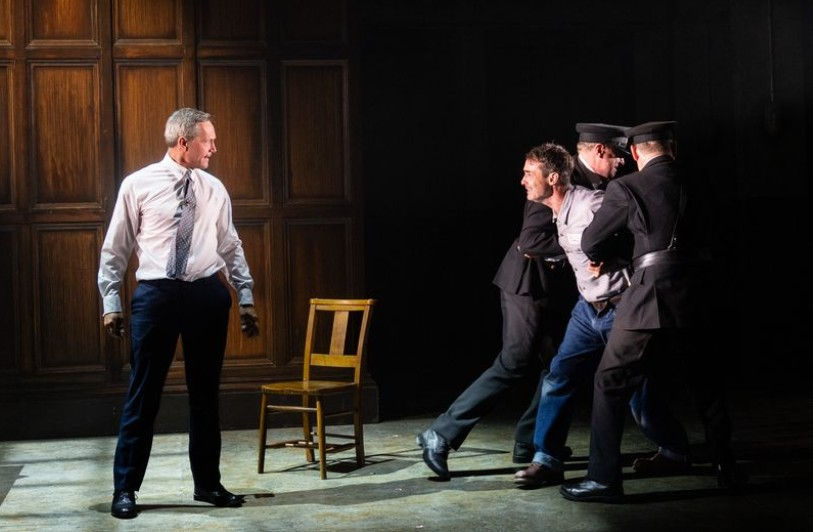
Above: Bill Ward (left) plays Warden Stammas. Photo by Jack Merriman.
As we the audience are aware however, the mild-mannered banker is no pushover at the chess board, and you might not notice you’re in checkmate until it’s too late.
Director David Esbjornson and the all-male cast together generate a simmering and oppressive sense of tension which is aided by McCann’s design and augmented by Chris Davey’s often claustrophobic lighting.
Meanwhile Onwukwe is utterly compelling as the pragmatic Red, the story’s putative narrator whose first-person testimony drives the narrative over the course of two decades (the sense of time passing is flagged up by an ever-changing cultural soundscape of books, films and above all, music).
The denouement, when it comes, feels a little bit underplayed and underexplored – (plot spoiler) after two solid hours of action which lead up to it, we never really learn the full story of Andy’s great escape.
Still, as a study of resilience, comradeship, perseverance, the power of hope and the unquenchable nature of the human spirit in the face of isolation, corruption, brutality and institutional oppression, this Shawshank Redemption is a powerful and absorbing piece of live storytelling.