


Liverpool galleries to mark Julia Carter Preston centenary
The centenary of the birth of acclaimed Liverpool ceramicist Julia Carter Preston will be celebrated with a series of exhibitions at Liverpool galleries this autumn.
The Bluecoat, Bluecoat Display Centre, Walker Art Gallery, Victoria Gallery & Museum and Liverpool Hope University will all showcase the work of the late artist who was best known for her ‘sgraffito’ (scratched) style of pottery design.
The programme of events - titled Julia Carter Preston, Ceramicist – starts on September 11 and will include exhibitions at the five venues and a symposium looking at her art and its significance to post-war British ceramics.
Julia Carter Preston was born into an artistic family in the city on August 31, 1926, and died, aged 85, in 2012.
Her father was the renowned Liverpool sculptor Edward Carter Preston, whose work included the bronze memorial plaques – known widely as ‘death pennies’ – given to the families of the fallen in the First World War, and the 1939-45 War Medal. He also carved the memorials at each end of the Queensway Tunnel and was head sculptor at Liverpool Cathedral from 1931-65.
Her mother was the watercolourist Marie Tyson Smith, sister of the famous Liverpool sculptor Herbert Tyson Smith.
Carter Preston was the youngest of four daughters, all of whom would go on to enjoy their own artistic careers – one sister as a sculptor, another as a jeweller and the third as an ecclesiastical embroiderer.
She studied at the Liverpool College of Art where she went on to teach, in 1960 being made head of ceramics.

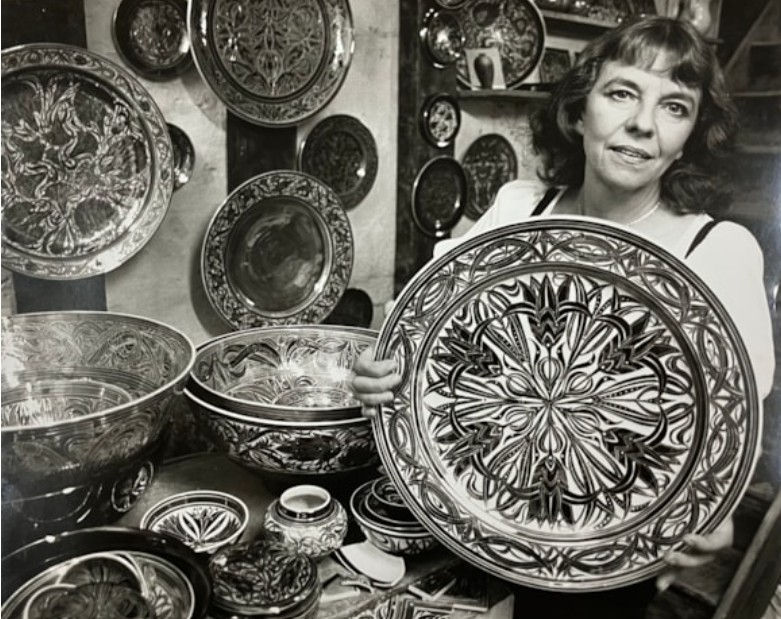
Above: Julia Carter Preston in her studio in the 1950s. Top: Carter Preston at the Bluecoat in 1980. © LHCPF
In 1951 she started working in a studio at the Bluecoat, where two of the centenary exhibitions – an archive display and an exhibition featuring examples of her work alongside that of contemporary sgraffito artists – will be staged.
Carter Preston was recognised for the role she played in reviving the technique of sgraffito in the 20th Century. With ancient origins and popularised in Renaissance Italy, sgraffito involves scratching through a coating of clay slip on a surface to reveal an underlying layer, creating contrasting decoration.
She used this technique to brilliant effect, often using metallic lustre glazes on a wide range of ceramics – bowls, plates, jars, tiles, even a complete dinner service. She was in great demand, commissioned to create plaques and other pieces to commemorate anniversaries or celebrate special occasions.
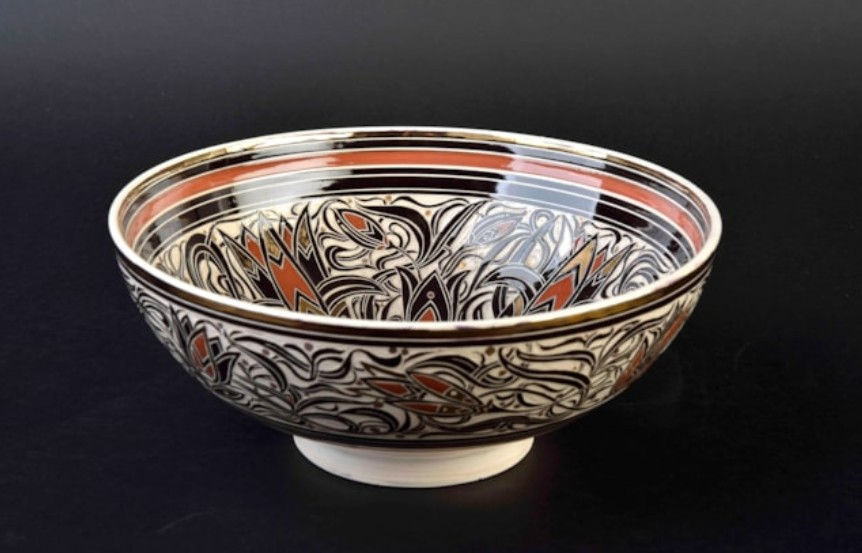
Above: Julia Carter Preston bowl, made 1985, earthenware, ‘sgraffito’ and gold lustre decoration. ©National Museums Liverpool, Walker Art Gallery
Her designs were characterised by flowing and intricate patterns based on natural forms that echoed the designs of William Morris and Islamic art.
Along with exhibitions at the Bluecoat, the centenary programme is also set to include an an exhibition of her ceramics and other material selected from the Liverpool Hope Carter Preston Foundation’s collection which is housed at the university and comprises work by Julia Carter Preston and her father.
The Walker Art Gallery will showcase outstanding pieces of Julia’s work from the collection of National Museums Liverpool, acquired from the University of Liverpool, the Bluecoat Display Centre or through bequests by local collectors.
And the Victoria Gallery & Museum will include two examples of her lustre ware artworks - a lustre glaze bowl and a lidded jar with sgraffito figuring and lustre glazes, both from 2001 – shown alongside other highlights from the University of Liverpool's ceramics collection.