


Review: Bember at the Unity Theatre ****
One of the few positive things to emerge from the Covid pandemic was the Unity Theatre’s Up Next Festival – designed to support and nurture new work by local talent.
This year’s Up Next is the fifth annual festival, and over four days (it runs until Saturday) it is showcasing 20 pieces at various different stages of development, from rehearsed readings to fully formed productions.
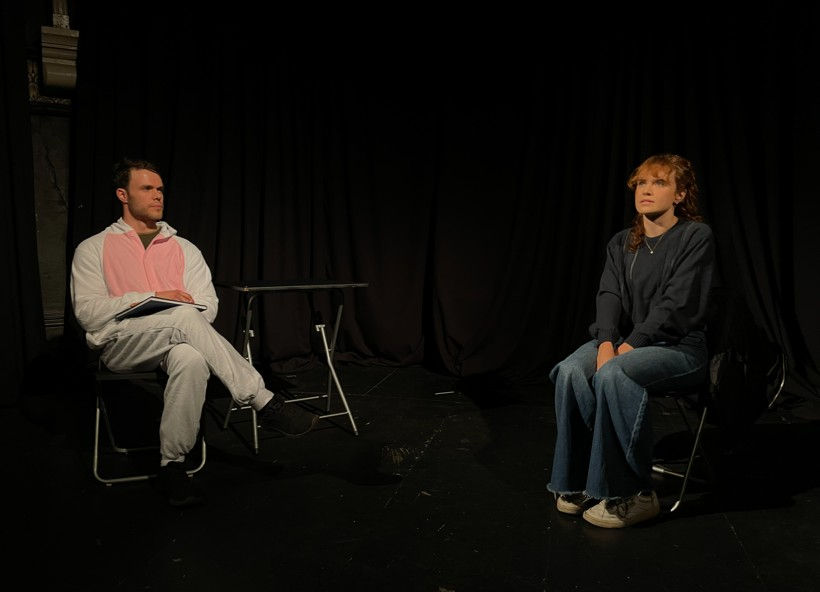
Up first at Up Next on its opening night was Bember, Winnie Grace Southgate’s dark comedy/comi-tragedy set in a therapist's office. Southgate’s piece was previously presented as part of a Unity scratch night in January last year and I'd suggest is at the more fully formed end of the festival spectrum.
The actor-writer plays Bember (as in November, the strange Christian name bestowed on her by her parents, and shortened by her baby sister who couldn’t pronounce the whole thing).
Skittish, chaotic and emotionally elusive, Bember – known by her middle name Martha – appears on stage shadowed by a giant bunny, one that is a sight more sinister than the mischievous and benign Harvey of the 1950 Hollywood film, and also converses with creepily disembodied singsong child’s voice.
Something is definitely off kilter, but it’s only as Southgate’s prickly protagonist embarks, reluctantly, on a series of sessions with Danny O’Connell’s inscrutable shrink Dr Grayson that we get a sense of just how troubled and in need of help she really is.
We’re witness to the slow wearing away of a defensive shield evidently constructed over many years: one built on bravado, avoidance tactics, combative banter – “do you see conversations as something you need to win?” O’Donnell’s character asks at one point – and recklessness.
It doesn’t take a professional to diagnose that beneath that joke-filled bravado is a deep vulnerability, torment and a sense of shame and guilt which is weighing down this bright, brittle young woman.
While Southgate’s tale employs magical realism, she also invests Bember with believable thoughts, traits and (extreme) reactions. Cutting in and out of scenes to break the fourth wall and explain the background to her life – friends, family, events – also helps draw the audience into her orbit and on to her side.
O’Donnell is the straight man to her mercurial ‘funny’ girl, albeit one afforded some deadpan visual humour.
I’m not convinced by the ultimate destination of their characters’ narrative arc (no plot spoilers, but Dr Grayson suffers a lapse of professional judgement).
But as a (darkly funny) exploration of trauma, grief and the human condition, Bember is an absorbing and smart piece of storytelling.