


Open Eye's Self-Defined exhibition explores lives led under Soviet rule

Artists from Central and Eastern Europe explore their own families’ complex stories along with historical archives in a new exhibition at Liverpool’s Open Eye Gallery.
Self-Defined: New Stories from Archives, which opens today and runs until June 7, features the work of contemporary artists from countries which were occupied or influenced by the former Soviet Union, including Ukraine, Poland, Germany and Latvia along with ethnic Crimean Tartar communities.
The work explores independent or private archiving and the ‘non-existence or inaccessibility of material memory’.
In Mind of Winter, Karolina Gembara explores post-Second World War displacement and border changes through the stories of families from Poland, Germany, and Ukraine, centred on her own family history.
She grew up in a Polish family that had been relocated from Ukraine, inhabiting the German-built house in Poland vacated by the German family who was forced to move to Germany. The work combines contemporary staged photographs that respond to past events and images from the archive.
Andrii Dostliev’s Death of Lucretia is a ‘speculative and playful’ outcome of the long-standing research into a collection of commercially produced tourist photographs from the small town of Svitohirsk in the Donetsk region in the East of Ukraine.
And Lia Dostlieva’s Ten Faded Faces turns to the archives of her own family, also in Donetsk – or rather the absence of a family archive – the lack of photographs, documents, and records – compounded by a Soviet-era habit of silence, the fragmentation of relatives’ memories, and the nature of individual memory, which over time unconsciously reshapes and replaces recollections.
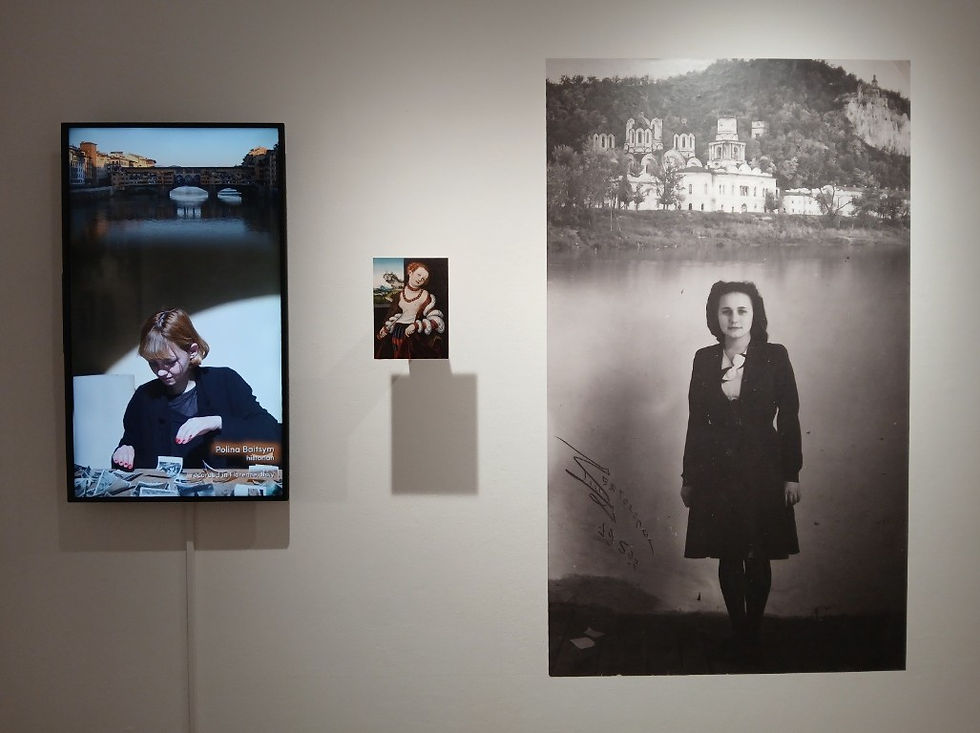
Above: Andrii Dostliev’s Death of Lucretia. Top: Emine Ziyatdin's Crimean Counter-Archive from Below.
Meanwhile Emine Ziyatdin has based her project Crimean Counter-Archive From Below on personal archives and her own family history to raise the issue of epistemic injustice – namely, how knowledge about the history of the Crimean Tatars in the 20th century has long been constructed from Soviet and later Russian perspectives, excluding authentic voices.
Decades of deportations, persecution, and exile of the Crimean Tatar people continue today following Russia’s annexation of Crimea in 2014.
Working with her family’s photographic archives, Ziyatdin - whose family was deported by the Soviets in 1944 and who was herself born in Uzbekistan - has reconstructed fragments of personal memory and gives voice to the experiences of hundreds of thousands of Crimean Tatars.
And in partnership with the National Library of Latvia and researcher and curator Līga Goldberga, Open Eye is also showcasing a selection of photographs from the archive of the late Latvian photographer Zenta Dzividzinska.

Above: The archive of Latvian photographer Zenta Dzividzinska.
The House Near the River is a decades-long photographic exploration of life in the Latvian countryside that the photographer started in the 1960s and continued throughout her photographic life. Goldberga has employed a feminist lens to articulate Dzividzinska’s creative practice.
Viktoria Bavykina, who has curated Self-Defined together with Open Eye Gallery’s Max Gorbatskyi, says: “This exhibition is the first attempt in our long-term work with photography archives from countries occupied or influenced by the Soviet regime, whose histories, legacies and lives were shaped by years of totalitarian and imperial rule.
“During this project, which we hope to build with our current and future partners across Europe, we want to commission artists and photographers to work with their local private, public and vernacular archives, reconsidering them from a contemporary perspective.”
The exhibition has been produced in partnership with The Liverpool European Festival, University of Salford and National Library of Latvia.
Self-Defined: New Stories from Archives is at the Open Eye Gallery until June 7. More details HERE